Introduction to Systems Analysis


Lecture 02

August 26, 2025

Review of Last Class

Course Policies

If you missed class last week, make sure you read the syllabus! and go through any needed computational tools setup

Recap of Grading Policies

  • Tag pages on Gradescope which are relevant for a given problem (labs this is the whole thing sans the intro/setup).
  • Explain what your code is trying to accomplish outside of the code block.
    • For example: here are the equations you’re implementing or this is how you’re iterating through a problem.
  • Make sure you include all elements needed for interpretation of e.g. plots.
  • When in doubt, ask!

Modeling Systems

How Do We Develop Models?

  • Mass balance equations let us track changes in stocks at particular points;
  • Equilibrium conditions are requirements that there is no net flow, and thus that stocks are preserved;
  • Fate and transport modeling involves quantifying how stocks change as they move through the system.

Systems Analysis

What We Study

  • System dynamics;
  • Response to inputs;
  • Alternatives for management or design.

Needs

  • Definition of the system
  • System model

What Do We Need To Define A System?

  • Components: relevant processes, agents, etc
  • Interconnections: relationships between system components
  • Control volume: unit of the system we are trying to model and/or manage
  • Inputs: control policies and/or external forcings
  • Outputs: measured quantities of interest

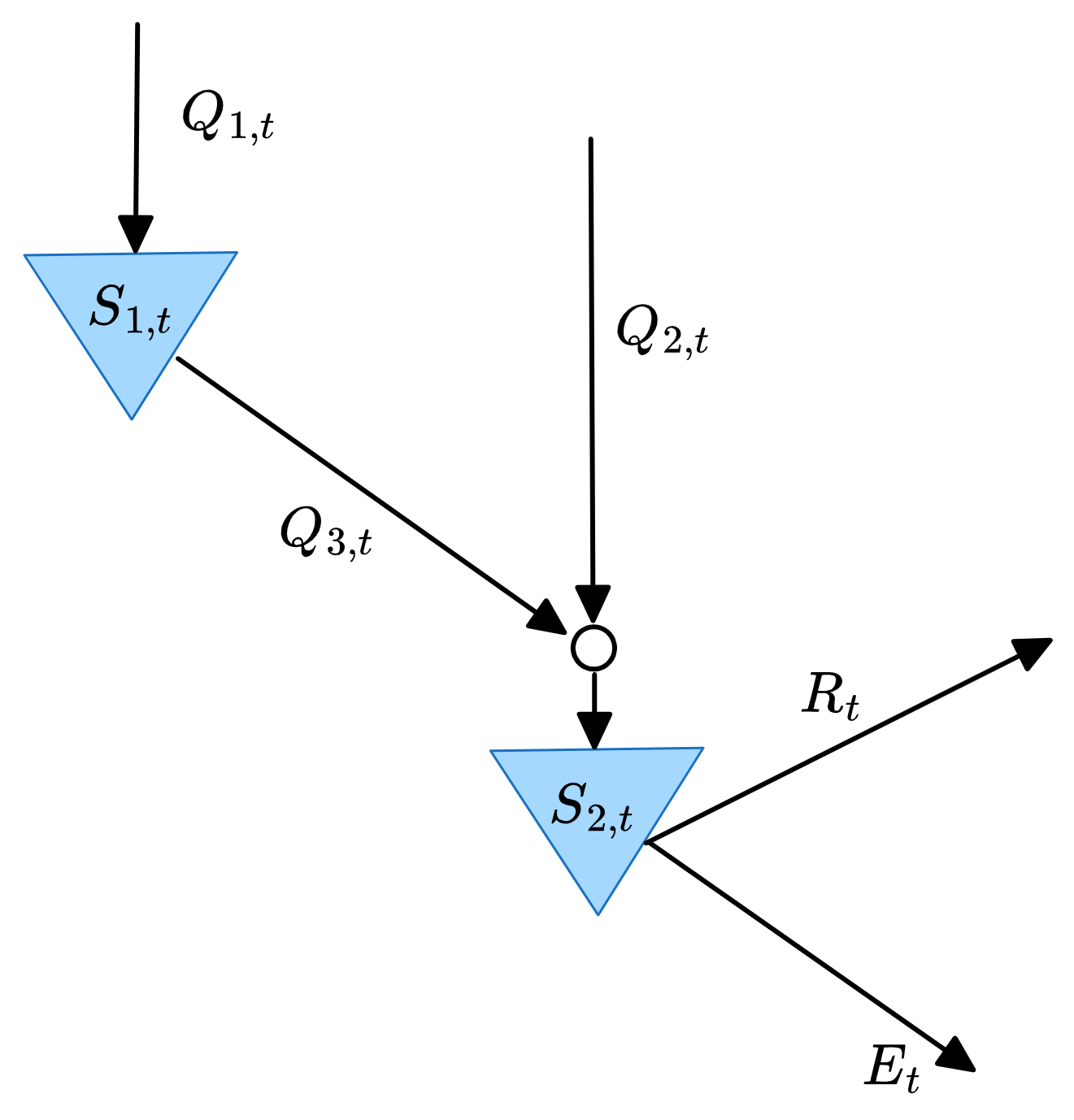
Example: Reservoir System

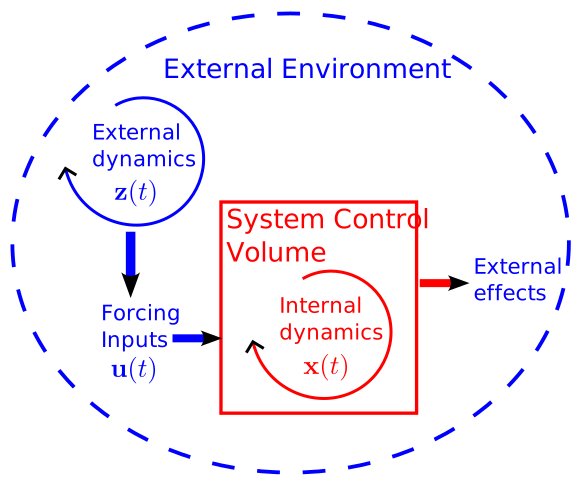
Figure 1: Illustration of a system, including notation.

What Is A Model?

Physical Models

Falling Water Miniature Model

Source: Wikimedia

Mathematical Models

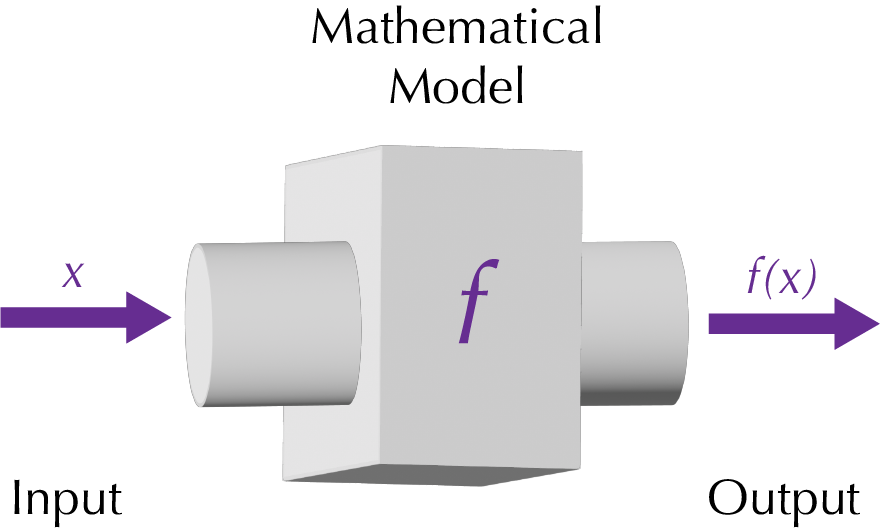
Mathematical Model Machine

Mathematical Models of Systems

Conceptual Model of a System

Environmental Systems
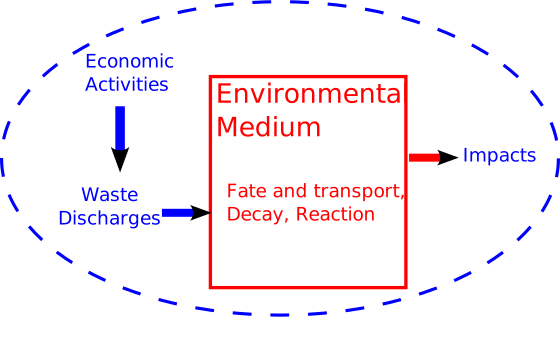
Conceptual Model of an Environmental System
  • Municipal sewage into lakes, rivers, etc.
  • Power plant emissions into air
  • Solid waste placed on landfill
  • CO2 into atmosphere

Deterministic vs. Stochastic Models

Deterministic Models

t t+1 Time State

Stochastic Models

t t+1 Time State

Descriptive vs. Prescriptive Models

Descriptive Models

  • Used primarily for describing or simulating dynamics.
  • Intended for simulations and exploratory and/or Monte Carlo analysis.

Prescriptive Models

  • Specify (prescribe) an action, decision, or policy.
  • Intended for optimization or decision analysis.

Analytic vs. Numerical Solutions

Mathematical models can be solved:

  1. Analytically: can find the exact solution in closed form;
  2. Numerically: can only find solutions (exact or approximate) using computational tools.

“All Models Are Wrong, But Some Are Useful”

…all models are approximations. Essentially, all models are wrong, but some are useful. However, the approximate nature of the model must always be borne in mind….

— Box & Draper, Empirical Model Building and Response Surfaces, 1987

What Are Models Good For?

Models can corroborate a hypothesis by offering evidence to strengthen what may be already partly established through other means…

Thus, the primary value of models is heuristic: Models are representations, useful for guiding further study but not susceptible to proof.

Models And Assumptions

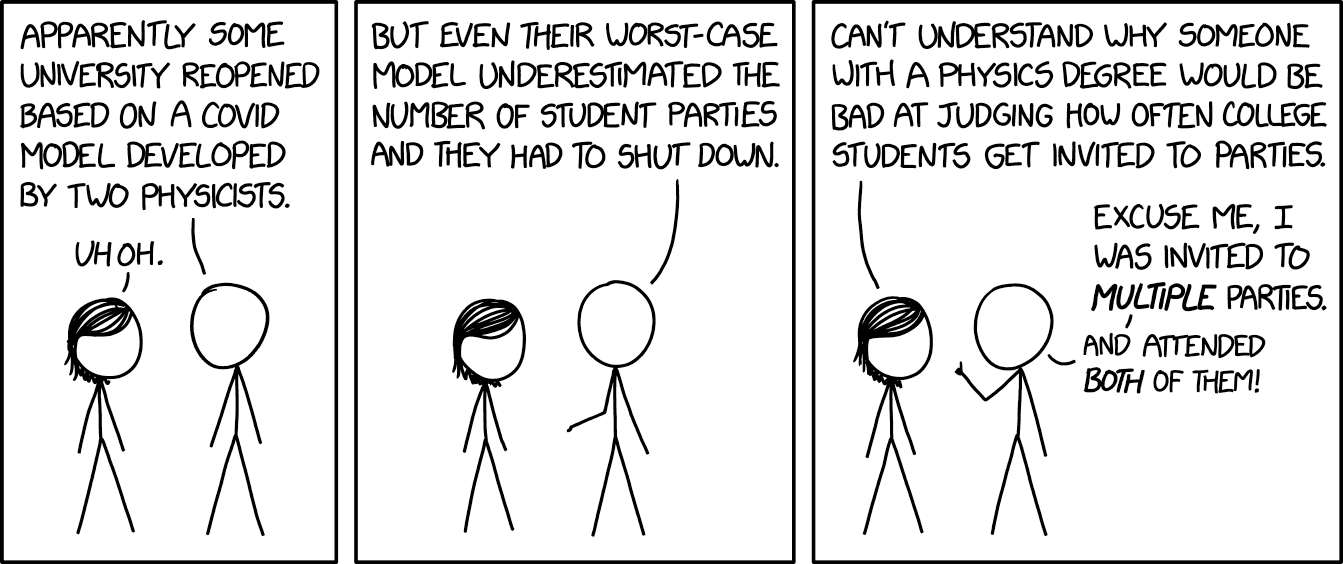
XKCD Comic 2355

Source: XKCD 2355

Example: Perturbed Phosphorous Cycle

System Model

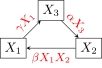
System with following stocks (in \(\mu\)mol/L):

  • \(X_1\): P in living biomass;
  • \(X_2\): P in inorganic form;
  • \(X_3\): P in dead organic matter.
Figure 2: Phosphorous cycle diagram

Steady-State Conditions

  • \(\bar{X_1} = 0.2 \mu\text{mol/L}\);
  • \(\bar{X_2} = 0.1 \mu\text{mol/L}\);
  • \(\bar{X_3} = 1.0 \mu\text{mol/L}\).
Figure 3: Phosphorous cycle diagram

Residence time of P in living biomass is 4 days. The system is perturbed by an inorganic P addition of 0.02 \(\mu\)mol/L. What is the new steady-state P in each stock?

What Does This Model Assume?

  • Steady-state: no continual fluctuations in stocks and flows;
  • Close to linear flows: easy to solve equations;

Good and useful for back of the envelope calculations, but may not be realistic!

Key Takeaways

Key Takeaways (Systems)

  • A system is an interconnected set of components.
  • Systems are interesting because interconnections can result in unexpected outcomes.
  • Key terms:
    • state
    • stocks
    • flows

Key Takeaways (Systems Definition)

  • To define a system, need to specify:
    • components
    • interconnections
    • control volume
    • external inputs
    • outputs of interest

Key Takeaways (Models)

  • Mathematical models allow us to understand how external inputs combine with internal system dynamics to produce outputs.
  • Models can be prescriptive or descriptive depending on goal of analysis.
  • For most interesting problems, cannot solve analytically and need to use numerical methods.

Key Takeaways (Models)

  • Simulation models: Generate data by evaluating model to represent system dynamics.
  • Optimization model: Find parameters which maximize/minimize some criterion.

Key Takeaways (Warning!)

  • All models are at best approximations: be conscious of what assumptions you’ve made and how they might change the modeled outcomes (you will be asked to do this on homeworks).

Upcoming Schedule

Next Classes

Monday: More Examples of Systems Models

Wednesday: Feedbacks & Equilibria

Assessments

Homework 1: Due next Thursday (9/3) at 9pm.

References

References